
A data-driven look at how IT outages drain revenue, productivity, and client trust, and why proactive management is the most cost-effective investment a Phoenix business can make.
By Jeff Wisdom, Founder & CEO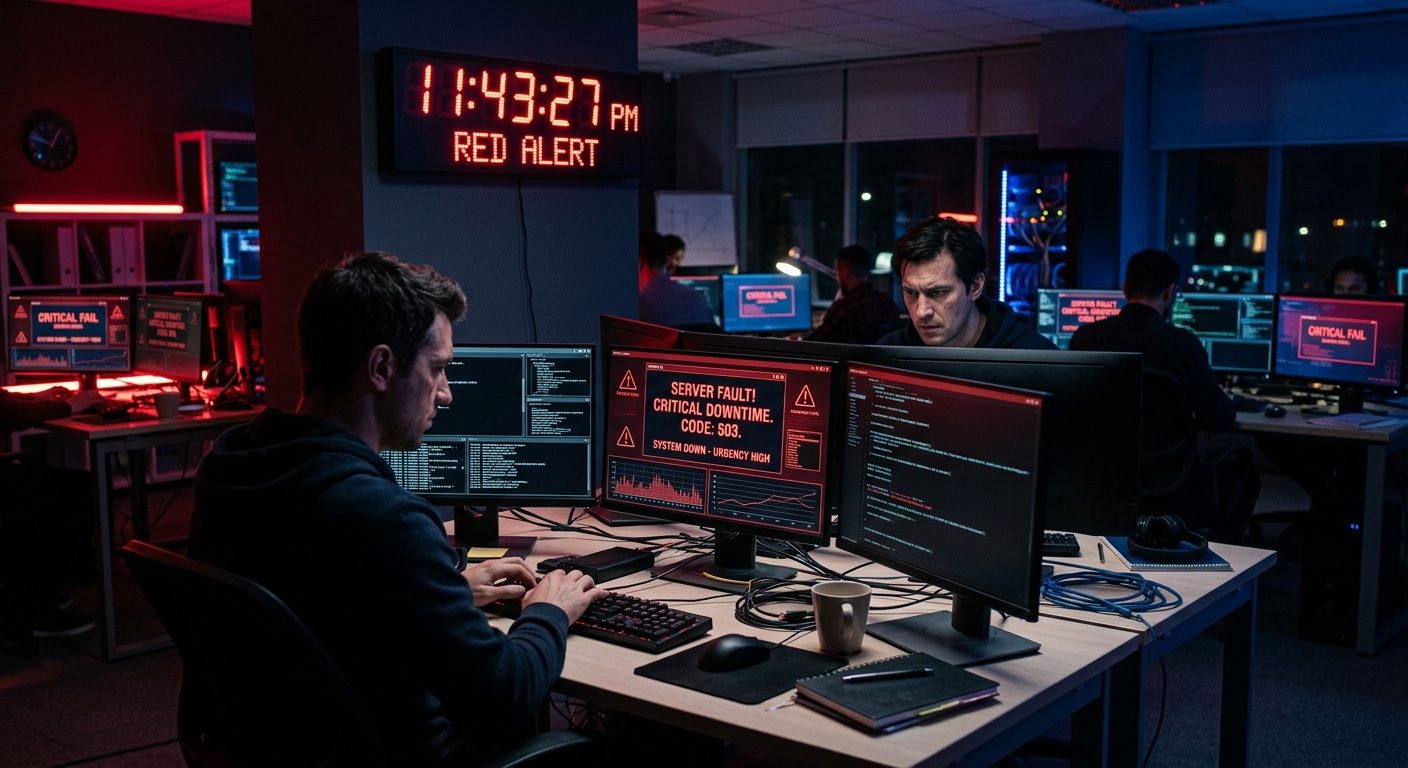
When your email goes down for an hour, it feels like an inconvenience. When your server crashes for a full business day, it feels like a crisis. But in both cases, most Phoenix business owners dramatically underestimate the true financial impact of IT downtime on their company.
Downtime is not just lost revenue during the outage. It is wasted employee wages, emergency repair bills, damaged client relationships, missed deadlines, and long-term reputation harm that compounds with every incident. For small and mid-sized businesses in Phoenix, where competition is fierce and margins are tight, even a few hours of unplanned downtime per year can cost tens of thousands of dollars. This article breaks down the four categories of downtime costs, walks you through a real cost calculation for a typical Phoenix SMB, and shows you exactly why proactive IT management pays for itself many times over.
Part of the Managed IT Services guide — our complete guide to managed IT services for Phoenix businesses, from service models and provider selection to proactive management.
Most business owners think of downtime costs in terms of lost revenue. But that is only one of four distinct cost categories that add up during every outage. Understanding all four gives you the complete financial picture.
Lost revenue is the most obvious cost. Sales that cannot be processed, deals that stall because your team cannot access email or CRM, billable hours that evaporate when your attorneys or consultants cannot work. For a Phoenix professional services firm billing $200 per hour across 20 billable staff, every hour of downtime represents $4,000 in revenue that will never be recovered.
Lost productivity affects every employee, not just revenue-generating staff. Your entire team sits idle or works at reduced capacity without their normal tools. A 30-employee company paying an average of $35 per hour (including benefits) loses $1,050 in wasted wages for every hour of company-wide downtime, even if those employees are not directly generating revenue.
Recovery costs are the expenses you incur to fix the problem: emergency IT service calls (often billed at premium rates), overtime pay for staff catching up on lost work, data recovery services, potential ransom payments, hardware replacement, and consultant fees. A single ransomware incident can easily generate $50,000 to $150,000 in recovery costs for a small business.
Reputation and relationship costs are the hardest to quantify but often the most damaging. Missed deadlines erode client trust. Failed transactions frustrate customers. Repeated outages signal instability to prospects. Negative reviews from frustrated customers compound online. And the best employees start looking for opportunities at companies with more reliable technology.
Let's walk through a concrete example. Consider a 30-employee professional services company in Phoenix with $3 million in annual revenue.
Revenue per productive hour equals approximately $180 per employee (based on standard 2,080 annual work hours and accounting for non-revenue-generating staff). One hour of company-wide downtime costs $5,400 in lost revenue alone. Add $2,400 in wasted wages (30 employees at $80 average total compensation per hour, accounting for varying roles). Include recovery costs of $500 to $2,000 depending on the incident type. That brings a single hour of downtime to $8,300 to $9,800 for this company.
The average SMB experiences 14 hours of unplanned downtime per year. For our example company, that translates to $116,200 to $137,200 in annual downtime costs. Now compare that to the annual cost of comprehensive managed IT services for 30 users at $150 to $200 per month: $54,000 to $72,000 per year. Even if managed IT prevents just half of those downtime hours, the service pays for itself. In practice, businesses with proactive monitoring experience dramatically fewer and shorter outages, making the return on investment significantly higher.
Understanding what causes downtime helps you appreciate why proactive management is so effective at preventing it.
Cybersecurity incidents are the leading cause, cited by 84% of organizations. Ransomware can lock your operation for days. Phishing compromises expose sensitive data and trigger compliance violations.
Hardware failure is particularly relevant in Phoenix, where extreme heat (regularly exceeding 110 degrees in summer) accelerates component degradation. Equipment that lasts five years in a climate-controlled data center may fail in two to three years in an improperly cooled server closet.
Human error accounts for a significant percentage of outages. Accidental file deletion, misconfiguration, and falling for phishing emails are all preventable with the right tools and training.
Software failures and unpatched vulnerabilities cause outages when critical updates are neglected. Automated patch management eliminates this risk.
Internet and power outages are a particular concern during Phoenix's monsoon season (June through September), when lightning strikes and power surges can knock out infrastructure.
Proactive IT management shifts the focus from fixing problems to preventing them. Every component contributes to keeping your business running.
24/7 monitoring catches failing hardware before it crashes. When a hard drive shows early signs of failure, your MSP replaces it during a planned maintenance window instead of dealing with a crash during business hours. Automated patch management closes security vulnerabilities on schedule, eliminating the backlog of uninstalled updates. Regular backup testing verifies that your data is actually recoverable, not just backed up. Security awareness training helps your team recognize phishing attacks and social engineering schemes before they cause damage.
The compounding effect matters. Repeated outages erode employee morale, deteriorate customer trust, and push your best people toward competitors with more reliable technology. Proactive management breaks this cycle by preventing the incidents that start the downward spiral.
More articles in the Managed IT Services guide:
Get expert help. Explore proactive IT maintenance in Phoenix to put this into practice for your business.
QBitz Insight
"We track a metric called 'Prevented Incidents' for every client. On average, our proactive monitoring systems detect and resolve 23 potential issues per month per client before they cause any user-facing disruption. That is 23 potential help desk tickets, productivity interruptions, or outages that never happen."
A: The cost varies based on your industry, number of employees, and revenue, but the numbers are consistently higher than most business owners expect. A 2025 ITIC study found that 78% of SMBs lose over $10,000 per hour of downtime. For a Phoenix professional services firm with 25 employees and $2.5 million in annual revenue, a four-hour outage can cost $15,000 to $25,000 when you factor in lost productivity, missed deadlines, recovery expenses, and client impact. For businesses processing transactions (retail, e-commerce, medical billing), the costs escalate further.
A: Cybersecurity incidents are now the leading cause of downtime, cited by 84% of organizations in recent surveys. This includes ransomware attacks, phishing compromises, and malware infections. The second most common cause is hardware failure, which is particularly relevant for Phoenix businesses because extreme heat (regularly exceeding 110 degrees in summer) accelerates component degradation in improperly cooled server environments. Human error, software bugs, and internet/power outages round out the top five.
A: No provider can guarantee 100% uptime because some events are beyond any provider's control (major ISP outages, widespread power failures, acts of nature). However, proactive managed IT services dramatically reduce both the frequency and duration of downtime. Organizations using proactive monitoring report significantly fewer outages, and when incidents do occur, they are resolved faster because the MSP has documentation, monitoring data, and tested recovery procedures already in place. A realistic target is 99.9% uptime, which translates to less than 9 hours of total downtime per year.
A: Phoenix's extreme heat creates unique challenges for IT equipment. Server rooms and network closets that are not properly cooled can reach temperatures that cause hardware to throttle performance, produce errors, or fail entirely. Summer power demand can cause brownouts and power fluctuations that damage equipment. Monsoon season (June through September) brings lightning strikes, power surges, and potential flooding that can knock out systems. A proactive MSP will assess your physical IT environment, recommend proper cooling, install UPS battery backup systems, and ensure surge protection is adequate.
A: Frame it in financial terms, not technical ones. Calculate your actual downtime cost using the formula in this article. Then compare it to the cost of managed IT services. For most Phoenix SMBs, the math is straightforward: if managed IT prevents even two to three significant outages per year, it pays for itself. Add in the reduced risk of a six-figure data breach, improved employee productivity, and strategic technology guidance, and the ROI becomes compelling. Ask your prospective MSP for case studies showing measurable outcomes for similar Phoenix businesses.
A: Start with three immediate steps. First, identify your most business-critical systems and data, and verify that you have working backups (test a restore, not just a backup log). Second, ensure all software is updated and patched, especially operating systems, email platforms, and any internet-facing applications. Third, schedule a professional IT assessment with a managed IT provider like Qbitz IT. A thorough assessment will identify your biggest vulnerability areas and give you a prioritized roadmap, even before you make a long-term commitment to managed services.
Pro Tip
Calculate your own downtime cost with this simple formula: (Number of employees affected) x (average hourly compensation including benefits) x (hours of downtime) + (hourly revenue / total work hours) x (hours of downtime) = Total downtime cost per incident. Run this calculation for your last IT outage and you will likely find the result is higher than you expected.
.svg)


.svg)
