
Traditional phone lines are costing your business more than you think. Here is why Phoenix companies are switching to VoIP and how to make the transition smoothly.
By Jeff Wisdom, Founder & CEO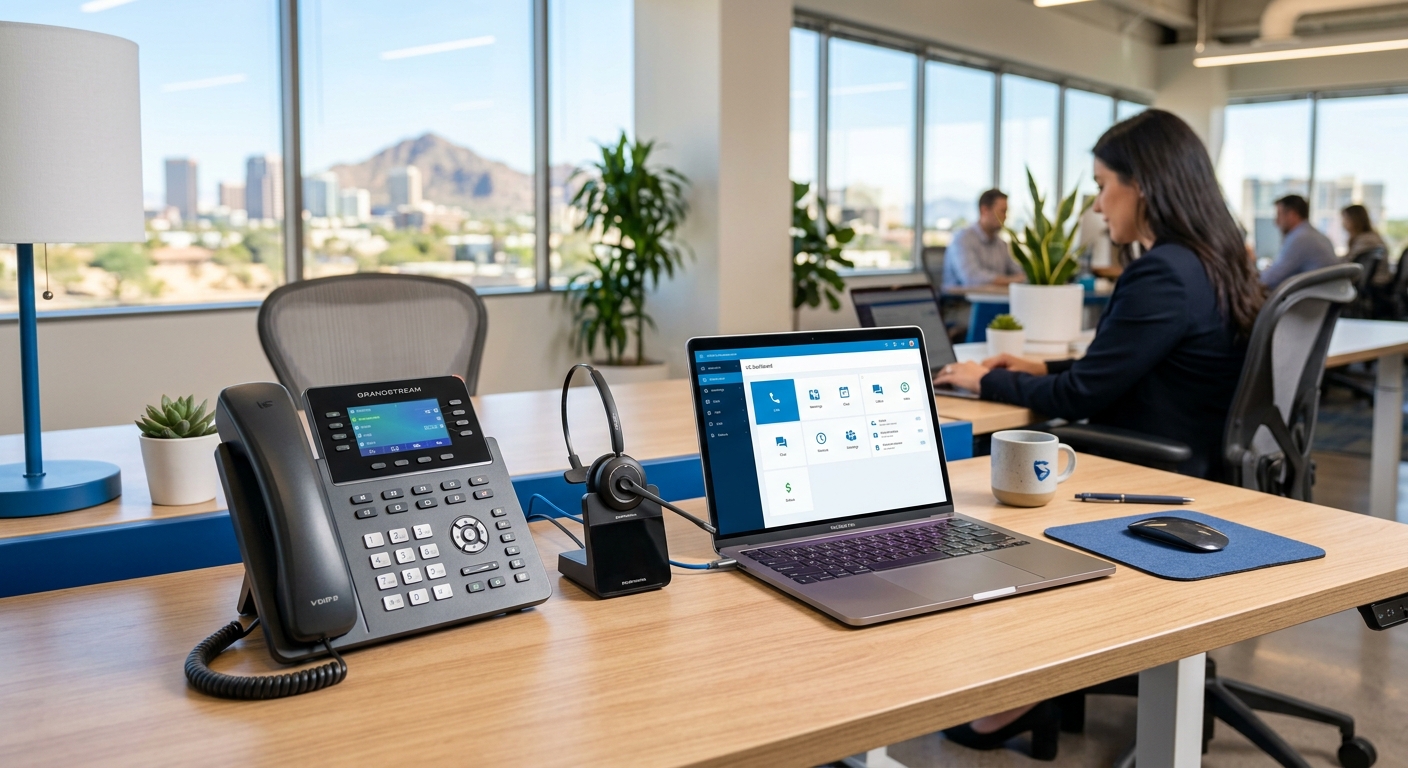
If your Phoenix business is still running on traditional phone lines, you are likely paying two to three times more than you need to for communications. Across the Valley, businesses of every size are replacing copper landlines with VoIP (Voice over Internet Protocol) phone systems that deliver better features, greater flexibility, and significantly lower monthly costs. The shift is not a trend; it is a fundamental change in how businesses communicate.
The numbers tell the story clearly. Businesses that switch to VoIP save an average of $1,200 per employee annually on communication costs. For a 15-person Phoenix office, that adds up to $18,000 in yearly savings. Beyond cost, VoIP delivers features that traditional phone systems simply cannot match: auto-attendant, voicemail-to-email transcription, mobile app access for field teams, video conferencing, and seamless integration with your CRM. This guide covers the real costs, the practical benefits, and the steps to transition your Phoenix business to a modern phone system without missing a single call.
Part of the Cloud Solutions & IT Infrastructure guide — our complete guide to cloud migration, infrastructure planning, and technology modernization for growing Arizona businesses.
Traditional landline phone systems cost Phoenix businesses $40 to $60 per line per month, and that base cost only covers basic calling. Add long-distance charges, hardware maintenance contracts, PBX equipment leasing, and the cost of adding new lines, and your total communication spend climbs quickly. A 15-person office with a traditional system can easily spend $1,200 to $1,500 per month before factoring in long-distance or conferencing add-ons.
VoIP systems run $15 to $50 per user per month with unlimited domestic calling, voicemail-to-email, auto-attendant, call forwarding, and conferencing all included in the base price. That same 15-person office drops to $225 to $750 per month. New businesses can reduce initial communication costs by up to 90% by choosing VoIP over traditional hardware-based phone systems, since there is no PBX equipment to purchase or install.
The savings extend beyond the monthly bill. VoIP systems are managed through a web portal, eliminating the need for on-site technician visits to add users, change call routing, or update your auto-attendant greeting. When your Phoenix business adds a new employee, you can provision their phone line in minutes from any computer. With a traditional system, that same change might require a service call and a two-week wait.
For businesses with remote or hybrid workers, VoIP eliminates the need for separate home office phone lines entirely. Employees use the same business number from their desk phone, laptop, or smartphone, presenting a professional image regardless of where they are working.
VoIP is more than a cheaper phone line. It is a complete communication platform that integrates voice, video, messaging, and collaboration into a single system. For Phoenix businesses, several features stand out as particularly valuable.
Auto-attendant gives your business a professional greeting and call routing without requiring a full-time receptionist. Callers hear a polished menu and reach the right person or department on the first try. This is especially useful for small businesses that want to project a larger, more established image to customers and prospects.
Call routing and forwarding ensure your team never misses an important call. Calls can ring desk phones first, then automatically forward to mobile phones after a set number of rings. During Arizona's summer months, when staff may work remotely to reduce commute time, calls follow them seamlessly. Field service teams in Phoenix can receive calls on their mobile app with the business caller ID, keeping personal and professional communications separate.
Voicemail-to-email transcription converts voice messages into text and delivers them directly to your inbox. Instead of dialing in and listening to messages one at a time, your team reads transcriptions and prioritizes responses. Call analytics provide data on call volume, peak hours, average call duration, and missed call rates, giving you visibility into communication patterns you never had with traditional phones.
CRM integration connects your phone system directly to your customer database. When a client calls, their record pops up on screen before you answer. Call history, notes, and recordings attach automatically to the customer profile. For sales teams and service businesses in Phoenix, this integration saves time and improves customer experience on every call.
The most common concern about VoIP is call quality, and it is a valid one. Voice quality depends entirely on your internet connection and network configuration. The good news for Phoenix businesses is that the metro area has strong broadband infrastructure with multiple fiber providers serving commercial districts throughout the Valley.
Each concurrent VoIP call requires approximately 100 Kbps of bandwidth in both directions. For a 15-person office where up to eight people might be on calls simultaneously, you need at least 1 Mbps dedicated to voice traffic. Most business internet plans in Phoenix exceed this requirement easily. The bigger consideration is not raw bandwidth but Quality of Service (QoS) configuration on your network. QoS settings prioritize voice traffic over other data, ensuring that a large file download or video stream does not degrade call quality.
For reliability, we recommend a dedicated business-class internet connection with a service level agreement for uptime. Consider a secondary connection from a different provider as failover. Phoenix businesses should also plan for monsoon season, when power fluctuations can occur. A battery backup (UPS) for your router and VoIP equipment, combined with cellular failover, ensures you maintain phone service during brief outages.
Configure your VoIP system to automatically route calls to mobile phones if your primary internet connection drops. This failover capability means your business never goes dark, even during Arizona's most severe weather events.
Switching from traditional phones to VoIP is less disruptive than most business owners expect. The process typically takes one to three weeks for a 10 to 25 person office, with most of that time consumed by the number porting process rather than technical setup.
Number porting transfers your existing Phoenix-area phone numbers (480, 602, 623 area codes) from your current provider to your VoIP service. This process takes 7 to 14 business days for local numbers and up to 30 days for toll-free numbers. Your old phone service remains active throughout, so there is no interruption to incoming calls. Once porting is complete, calls to your existing numbers route through the new VoIP system automatically.
During the transition, decide whether your team needs physical desk phones, software-based phones on their computers, mobile apps, or a combination. Many Phoenix businesses adopt a hybrid approach: desk phones at front desks and in conference rooms, softphone apps for office workers, and mobile apps for field staff. Your VoIP provider should offer hardware options at a range of price points, from basic phones at $75 to feature-rich models at $300.
Run both systems in parallel for at least two weeks before decommissioning your old phone lines. This gives your team time to learn the new system, verify call quality across all locations, and confirm that number porting is complete. Most VoIP providers offer trial periods, so take advantage of them to test thoroughly before committing. Training is straightforward; most employees adapt to the new system within a few days, especially if you start with the basics and introduce advanced features gradually.
More articles in the Cloud Solutions & IT Infrastructure guide:
Get expert help. Explore ISP & VoIP services in Phoenix to put this into practice for your business.
QBitz Insight
When we deploy VoIP systems for Phoenix businesses, network assessment is always the first step, not the phone system selection. We have seen businesses purchase VoIP service only to experience poor call quality because their network was not configured to prioritize voice traffic. Qbitz performs a complimentary network readiness assessment before any VoIP deployment to ensure crystal-clear call quality from day one. Call us at 480-900-2123 to schedule yours.
A: Yes, with proper planning. VoIP call quality depends on your internet connection, not weather conditions directly. However, monsoon season can cause power outages and brief internet disruptions. We recommend a battery backup (UPS) for your router and VoIP equipment, a cellular failover internet connection, and configuring your VoIP system to route calls to mobile phones automatically during outages. With these precautions, Phoenix businesses maintain reliable phone service year-round.
A: Yes. Number porting is a standard process that transfers your existing phone number from your current provider to your VoIP service. The process typically takes 7 to 14 business days for local numbers and up to 30 days for toll-free numbers. Your old phone service remains active during the porting process, so there is no interruption. All Phoenix-area numbers (480, 602, 623 area codes) can be ported to VoIP.
A: Each concurrent VoIP call requires approximately 100 Kbps of bandwidth (both upload and download). For a 15-person office where up to 8 people might be on calls simultaneously, you need at least 1 Mbps dedicated to voice traffic. Most Phoenix business internet plans easily exceed this requirement. The bigger consideration is Quality of Service (QoS) configuration on your network, which prioritizes voice traffic over other data to prevent call quality issues during heavy internet usage.
A: VoIP provides internet-based phone calling. UCaaS (Unified Communications as a Service) bundles phone, video conferencing, team messaging, file sharing, and sometimes contact center features into a single platform. If your business currently pays separately for phone service, a video conferencing tool, and a team messaging app, UCaaS consolidates everything into one monthly fee and one interface. Most Phoenix businesses with 10 or more employees find that UCaaS provides better value than standalone VoIP.
A: Not necessarily. You have several options: purchase VoIP-compatible desk phones ($75 to $300 per phone), use softphone apps on existing computers (no hardware cost), use mobile apps on smartphones (no hardware cost), or use a combination. Many Phoenix businesses adopt a hybrid approach, placing desk phones at front desks and conference rooms while equipping mobile employees with softphone apps. Your VoIP provider should offer hardware options that match your budget and workflow.
A: A basic VoIP deployment for a 10 to 25 person office typically takes 1 to 3 weeks from initial setup to full operation. This includes network assessment (day 1 to 2), system configuration and user setup (day 3 to 5), hardware installation if applicable (day 5 to 7), number porting submission (7 to 14 business days), and parallel testing. The longest wait is usually the number porting process, which is handled by the carriers. With a managed IT provider like Qbitz handling the deployment, the process is streamlined and minimally disruptive to daily operations.
Pro Tip
Before canceling your existing phone lines, run your new VoIP system in parallel for at least two weeks. This gives your team time to learn the new system, verify call quality, and confirm that number porting is complete. Also, configure your VoIP system to automatically failover to mobile phones if your internet connection drops, ensuring you never miss a call during Arizona's monsoon season when power fluctuations can occur.
.svg)


.svg)
